The iGaming Events Calendar Is Crowded. Who Is Counting the Cost?
Published
An analysis of calendar listings from 2014 to 2027 explores event clashes, organiser competition and the pressure on people whose working lives extend far beyond gaming.
A sponsor can send a second exhibition stand to another country. Sending a second version of the person who makes the decisions is considerably harder.
That is where the debate about the iGaming events calendar becomes real. Behind every announcement, expanded exhibition and new destination are people deciding where to spend their time, which relationships to prioritise and how many days they can afford to be away from the business they are supposed to be growing.
For organisers, a date is a commercial decision. For everyone receiving the invitation, it becomes another decision to make.
The familiar complaint is that there are too many events. But that phrase bundles several different problems together: overlapping dates, repetitive programmes, stretched sponsorship budgets, travel demands and the feeling that the industry is repeatedly asking the same people to be everywhere.
To examine what the calendar actually tells us, EEGaming.org reviewed a database generously supplied by iGamingCalendar.com. It contains 2,751 records with start dates spanning 2014–2027
Our thanks to iGamingCalendar.com for making this historical resource available. It gives the discussion something more substantial than competing announcements and anecdotal frustration. The analysis and editorial conclusions below are our own.
The findings point towards a more demanding question than whether the industry can fit another event into the year: how much useful participation can the people behind the industry sustain?
What the iGaming events calendar reveals about 2014–2027
The database does not support a neat story in which the number of events rises relentlessly every year.
It records 249 listings starting in 2014 and 251 in 2019. More recently, it contains 144 in 2024, 206 in 2025 and 238 in 2026. The 80 entries for 2027 represent an incomplete forward calendar as assessed on 17 November 2026.
That last number should never become a headline about the market shrinking. There is still time for organisers to announce, revise and add events.
Nor are these all equivalent gatherings. The archive includes conferences, exhibitions, online sessions, training, awards and social activities. A webinar and an international exhibition each occupy a row, but they make very different demands on a participant.
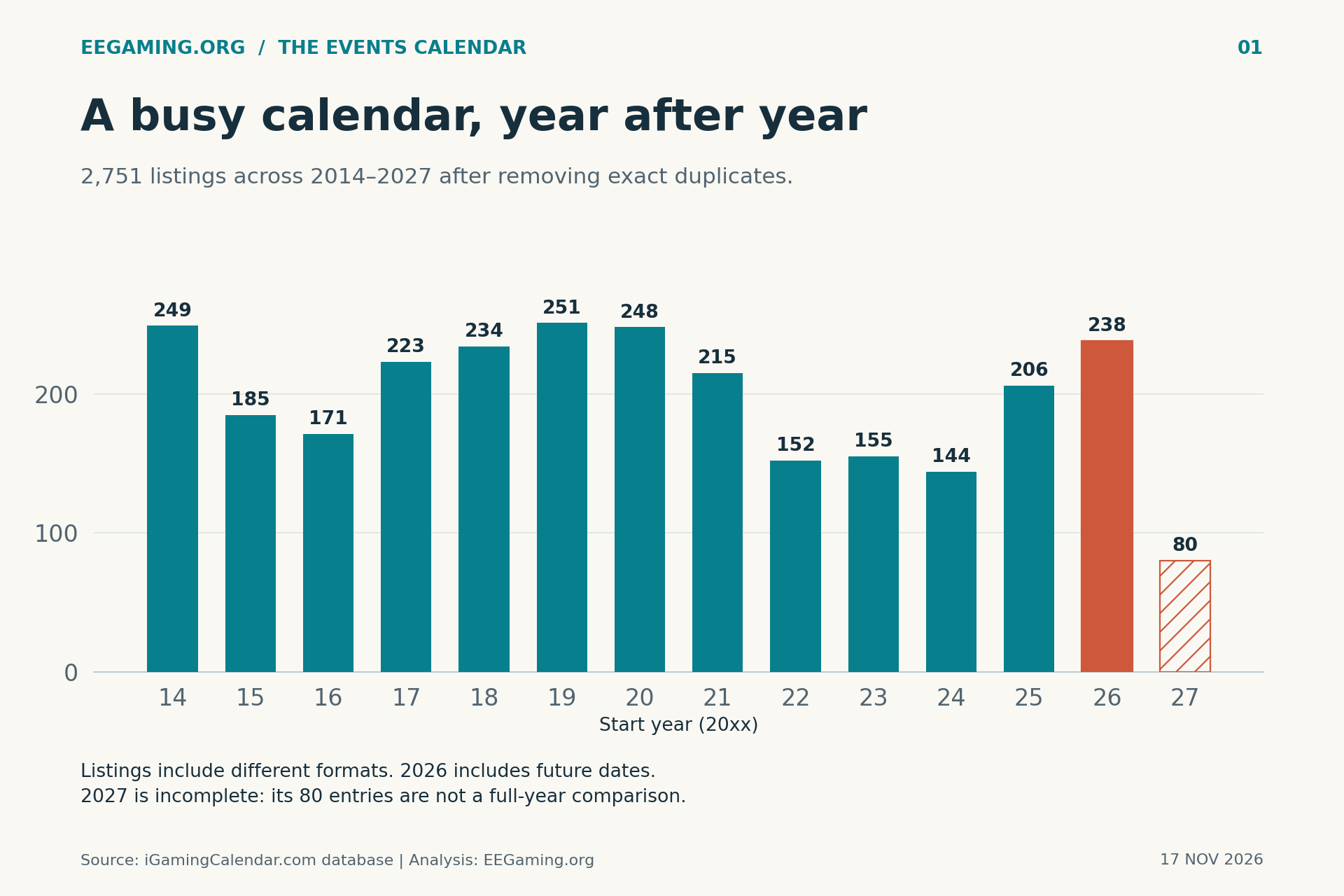
Calendar listings by start year. Source: database supplied by iGamingCalendar.com; analysis by EEGaming.org. The outlined 2027 bar is an incomplete forward calendar.
The important insight is that pressure does not require a record annual total. A year with fewer listings can still be difficult if the events most relevant to one business arrive within the same few weeks.
Imagine a payments company deciding between three conferences. Each has fewer than 2,000 delegates, but each brings together prospective clients the company wants to meet. Those dates may create more pressure for its commercial director than a dozen much larger exhibitions serving unrelated markets.
Calendar volume is useful context. Relevance determines the burden.
The busiest months leave less room than a full-year view suggests
Across the 2,671 listings starting in 2014–2026, June is the busiest month, with 337 starts. November follows with 319. September and October contribute another 275 and 267 respectively.
Together, September, October and November account for 32.2% of all starts in that period. Almost one-third of the archive is concentrated in one-quarter of the year.
By comparison, December accounts for 86 starts and August for 113.
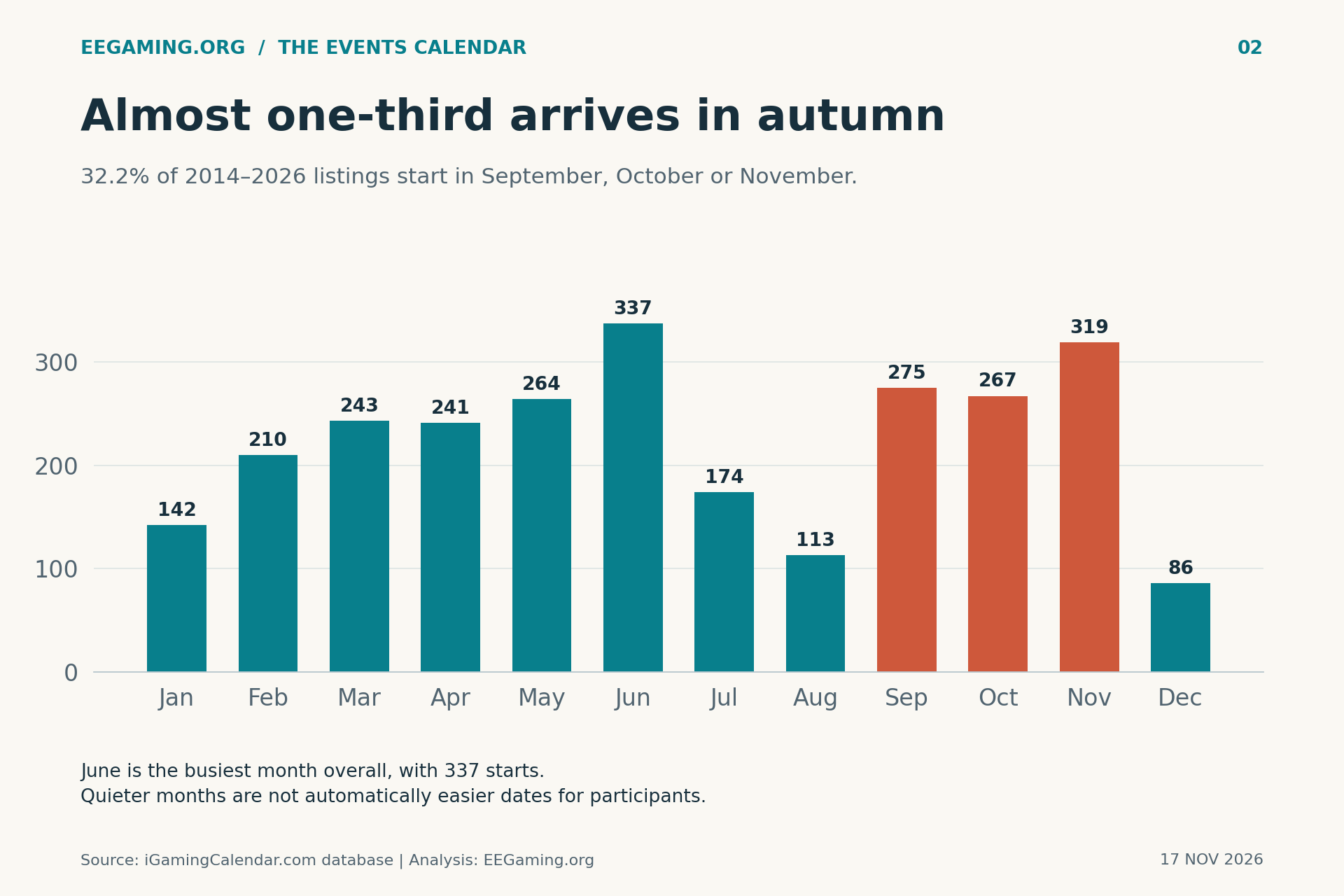
Nearly one in three listings starts in September–November. These are pooled historical totals, rather than a prediction for every future year.
An organiser looking at that pattern might be tempted to move into a quieter month. In practice, the white space on a calendar can be misleading. School holidays, religious holidays, venue availability, weather and customers' internal planning cycles all affect whether a seemingly available week is commercially useful.
The annual pattern also changes. In the 2026 export, November leads with 35 starts, followed by January with 32 and May with 28. June, the historical leader, has 24.
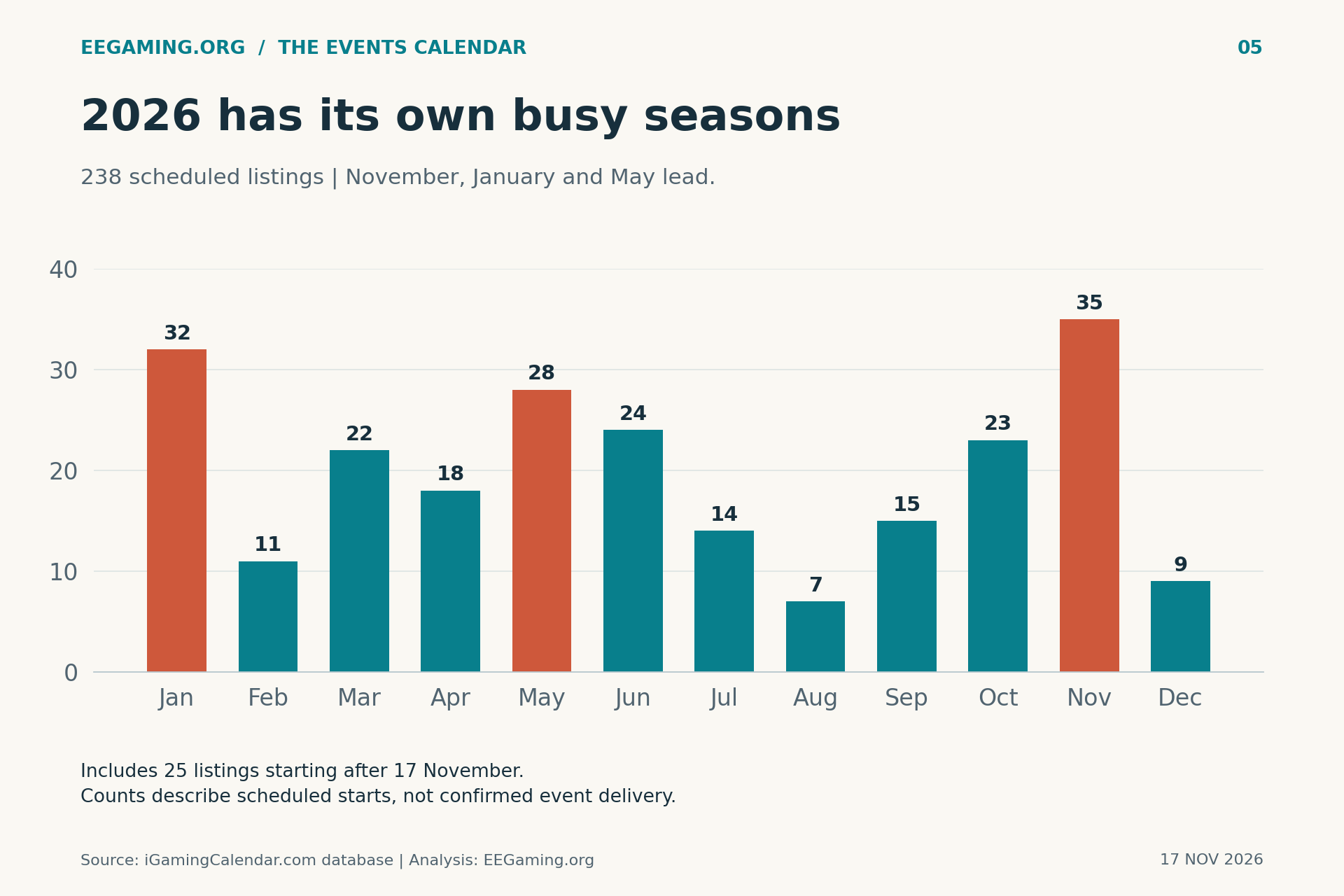
The 2026 calendar contains 238 listings, including 25 starting after the 17 November analysis date. Scheduled listings are not confirmation that every event took place.
This is why a fixed rule such as “avoid autumn” is too crude. Good planning needs both the longer view and a current understanding of the specific audiences being invited.
Rome and Valletta show how a calendar solution can create another clash
The reshaping of the 2027 iGaming events calendar offers a concrete example.
In its 5 November announcement, SiGMA explained that moving its Rome event to May was intended to create more balanced spacing between major European events. That is a reasonable objective: businesses need time between substantial exhibition commitments.
However, the SiGMA World event page advertises 24–27 May 2027 in Rome, while NEXT Summit Valletta advertises its main conference on 26–27 May 2027 in Malta, with surrounding activities earlier in the week.
Those main conference dates fall within SiGMA World's advertised event window.
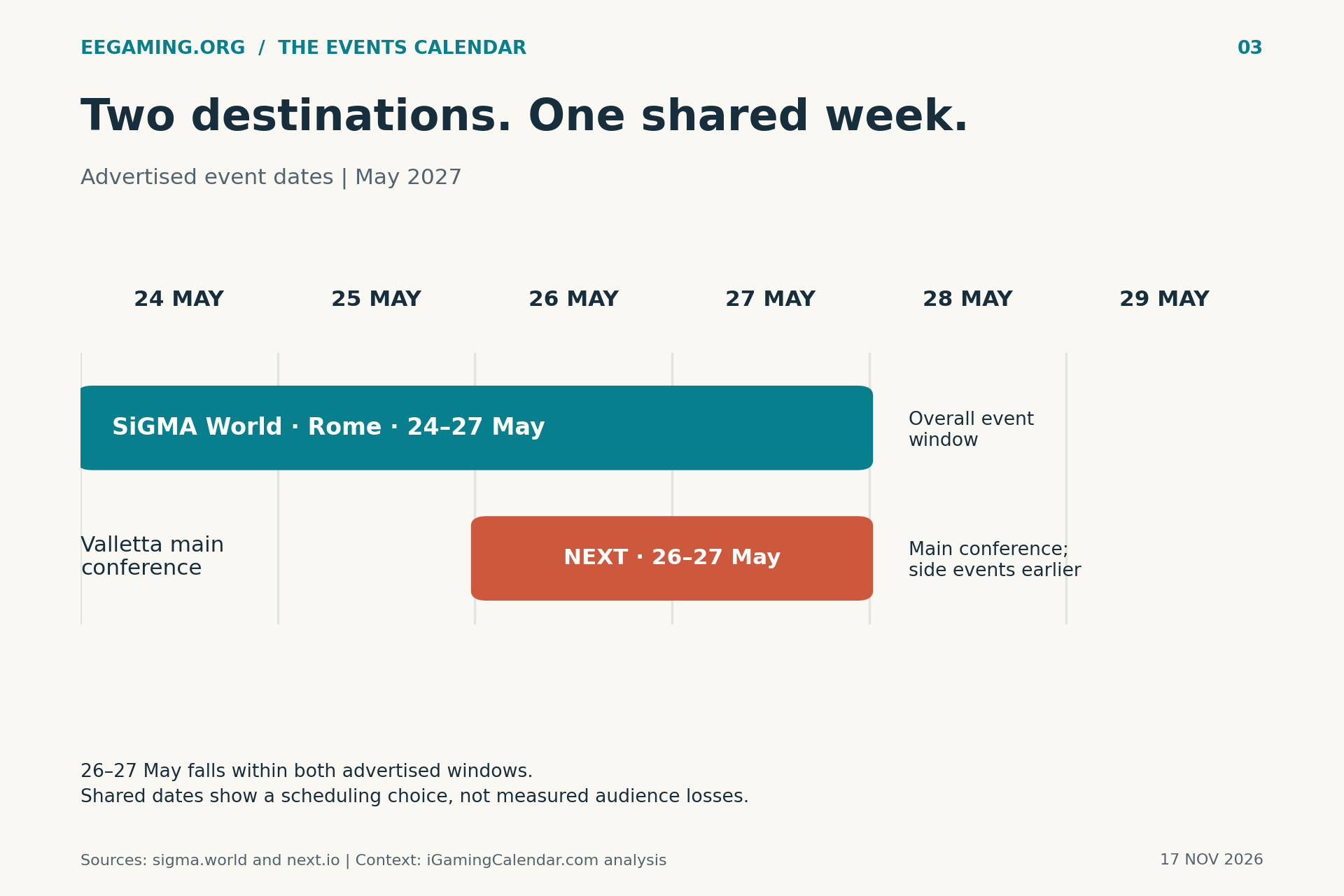
Official advertised dates checked on 17 November 2026. The comparison distinguishes SiGMA's overall event window from NEXT's main conference dates; daily exhibition schedules and surrounding activities may differ.
This does not establish anyone's motive. It illustrates a structural weakness in calendar planning: improving the spacing between a selected group of large exhibitions can still create difficult choices for another established audience.
The practical questions belong to the companies considering both trips. Which customers will be where? Can different teams cover the two destinations? Does the person responsible for signing a partnership need to attend personally? Is splitting the trip worth losing substantial time in transit?
A calendar can look more balanced from an organiser's portfolio perspective while becoming more complicated from a participant's perspective. Both experiences can be true.
There is more than one industry on the delegate's calendar
An iGaming calendar captures only part of the working year for many of the people the sector wants to attract.
A payment provider serves businesses beyond gambling. A cybersecurity specialist may work across banking, retail and public infrastructure. A lawyer advising operators may also be attending financial regulation meetings. An investor considering a gaming technology company may be evaluating AI, identity or enterprise software opportunities at other events.
These people do not suddenly acquire a separate diary when an invitation comes from another sector.
For HIPTHER, this is central to how we think about events. The conversations connecting gaming with fintech, banking, compliance, AI and cybersecurity are valuable because the underlying businesses share practical challenges. Payments, fraud prevention, digital identity and operational resilience do not stop at an industry label.
But broader programmes also create broader scheduling responsibilities. If an organiser wants to bring banking expertise into a gaming discussion, it needs to consider the banking calendar. If it wants credible cybersecurity practitioners, it needs to understand the commitments that already compete for their time.
The answer cannot be to celebrate cross-industry participation in the programme and then ignore it when choosing dates.
That is also why this database should be treated as a starting point. It helps map the gaming-related invitation landscape. It cannot show every competing commitment in the working lives of the people represented on stage or around the meeting table.
Organiser competition has a cost beyond the exhibition floor
Competition can improve events. It encourages better production, stronger agendas, more useful networking and sharper commercial propositions. An established organiser should not expect loyalty simply because it has occupied a week for several years.
The difficulty comes when competition over dates becomes a contest for presence rather than a contest over value.
The attendee then becomes the person expected to absorb the consequences: another flight, a shorter stay, a missed discussion or a difficult explanation to a longstanding partner. The sponsor becomes the business asked to find another budget allocation. The speaker becomes the professional expected to deliver a thoughtful contribution between departures.
For a large supplier, covering simultaneous events may mean dividing staff and sending additional equipment. A smaller company may have only one founder or senior commercial person who can represent it effectively. The same overlap therefore has very different consequences depending on the resources behind the badge.
Regional events face another version of that problem. They may serve a distinct local audience while still relying on some of the international speakers, sponsors and technology suppliers sought by global exhibitions.
An event does not need to be a direct replacement for another event to compete for part of its participation.
That distinction matters when discussing an “organisers' battle”. Dates alone cannot prove deliberate targeting. They can, however, reveal situations in which the cost of competing strategies is passed to shared customers.
Warsaw is part of the discussion, not the whole argument
HIPTHER has a direct interest in this issue, and that perspective should be explicit.
SBC's Miami event page, currently identifying the event as SBC Summit Latinoamérica, advertises 26–28 October 2027. That falls within the traditional late-October scheduling window relevant to HIPTHER's Warsaw planning.
HIPTHER's position at the time of this analysis is that Warsaw Summit 2027 has not been booked and is planned to move earlier; no replacement date is confirmed here. This is pressure on an established planning window, rather than a clash between two already-contracted events with fixed dates.
That distinction leaves room for a constructive response. An organiser can reconsider its own plans without claiming permanent ownership of a week, and it can raise the wider issue without suggesting that a regional European audience and a Latin American audience are identical.
Some participants may have no reason to consider both events. Others may work for companies serving both regions. The relevant question is how much of the decision-making, sponsorship and specialist expertise is shared.
The broader argument must stand beyond Warsaw. Otherwise, an industry discussion risks becoming a complaint about one organiser's inconvenience. The same standard should apply when HIPTHER chooses dates, expands a programme or enters a new subject area.
A busy destination can make participation more efficient
Several events in the same city are not automatically a problem.
A conference, an awards evening and a specialist breakfast can be part of one productive trip. A regional meeting attached to a larger gathering may enable people to participate who could not justify a separate journey.
Our location-text checks across the 588 listings starting in 2024–2026 found 48 entries explicitly mentioning London, 42 mentioning Barcelona and 40 mentioning Malta or selected Maltese localities. Lisbon and Rome each appear in 19, while spelling variants for São Paulo identify 15.
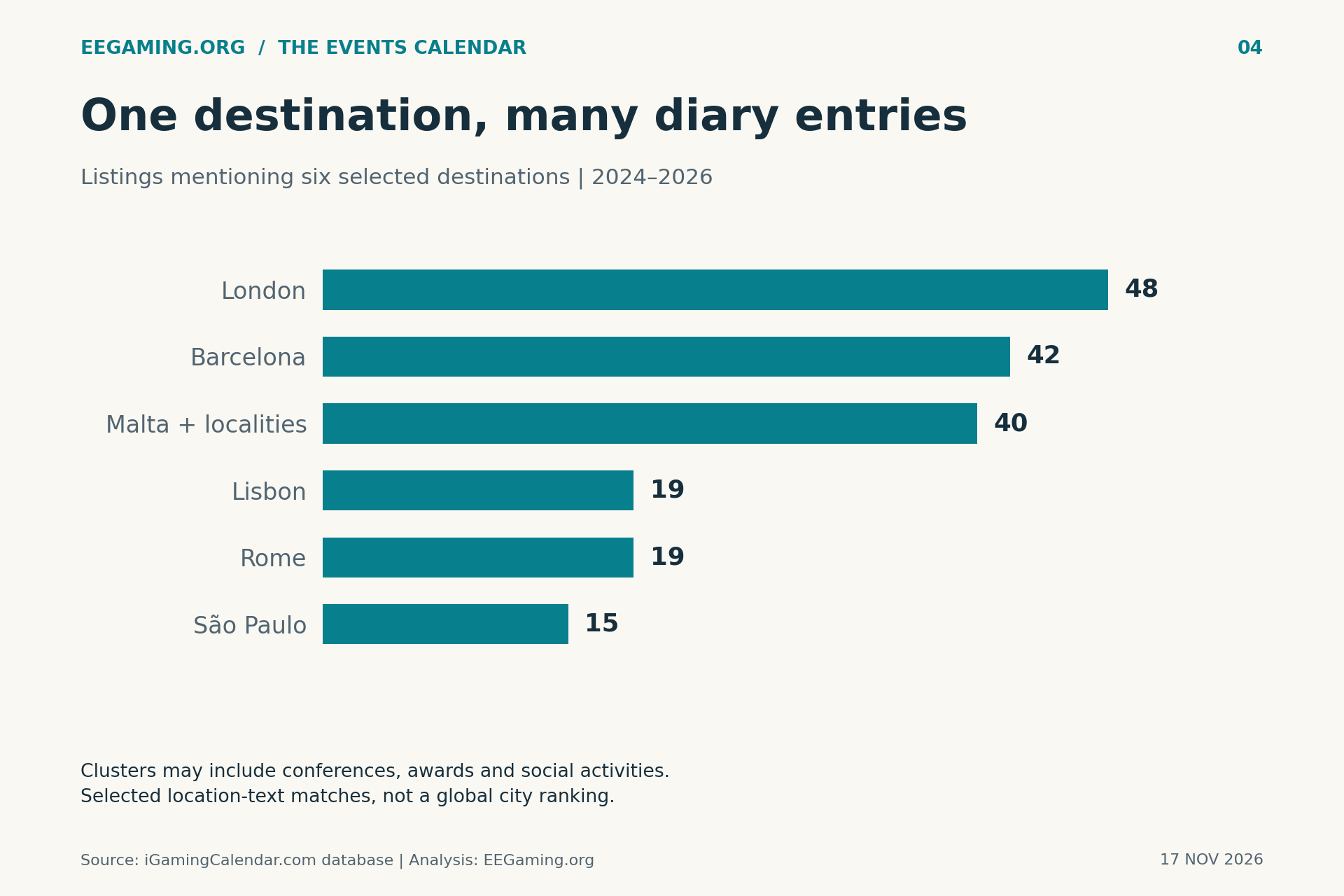
Selected destination matches, not a global ranking or market-share estimate. Malta combines named localities. Counts include different event formats and associated activities; matching rules are provided in the methodology.
These clusters can represent an efficient gathering of related communities. The question is whether the additional activities improve a visitor's trip or simply make the diary harder to manage.
Two specialist sessions serving different needs can work well alongside each other. Several competing invitations for the same senior executives at the same time may create frustration, even if every venue is within walking distance.
Geographical proximity helps with travel. It does not create extra hours in the day.
The business case for attending needs to survive the journey home
An event's price is more than the ticket, stand or sponsorship fee.
For a participating company, the commitment includes preparation, travel, accommodation, staff time and the work postponed while people are away. It also includes the time needed afterwards to turn meetings into something useful.
A calendar that leaves no room for follow-up can undermine the very commercial outcomes that made attendance attractive.
This suggests a better set of questions for sponsorship and event selection. Which people does the business need to meet? What decisions should those conversations advance? What knowledge will the team bring back? Who will follow up, and when will they have time to do it?
A large audience may be valuable for visibility and market discovery. A smaller, focused room may be valuable for an extended discussion with a regulator, an implementation partner or a prospective customer. Neither format wins automatically.
Organisers should be able to explain what their particular gathering makes possible. A claim about scale is useful only when it connects to the participant's purpose.
The archive cannot calculate the return on an exhibition investment or attribute lost sales to a clash. That requires company-level evidence. It can prompt a more disciplined conversation about where limited time and budgets are being directed.
Event fatigue is also about attention, recovery and unfinished work
The human side of the calendar deserves more than a passing reference.
For someone attending repeatedly, an event extends beyond the published conference days. Preparation may begin well before departure. Travel can consume the evening before the opening session and the day after the closing reception. Meanwhile, ordinary responsibilities continue.
The burden can include missed time at home, interrupted routines and the mental effort of remaining available to everyone while constantly changing location.
Those experiences are not measured in this database, and it would be misleading to turn listing totals into a numerical claim about exhaustion. Nevertheless, they belong in the planning conversation.
An organiser asking for two days is often asking for a larger portion of somebody's week. Two events that do not overlap on paper can still be impractical to attend consecutively.
Respecting that reality means allowing people to participate selectively, making agendas useful enough to justify the journey and accepting that a declined invitation may reflect capacity rather than disinterest.
There is little value in attracting an important person to the room if that person has no time or attention left for a meaningful conversation.
What a better iGaming events calendar would look like
A more useful calendar would help people understand the commitment before they make it.
Dates should distinguish the main conference or exhibition from optional surrounding activities. Tentative plans should be labelled as tentative. Changes should be easy to trace, and associated awards, dinners or workshops should be connected to their parent gathering.
That would make it easier to tell the difference between several listings supporting one trip and several events requiring separate trips.
Organisers also need to look beyond exact date matches. An event ending in one continent shortly before another begins elsewhere can create a genuine participation problem without a single shared conference day.
Direct conversations can help while plans remain flexible. The purpose is to understand likely audience pressure and practical alternatives, while each organiser retains responsibility for its own decisions.
Sponsors have an important role, too. Clear information about the teams, markets and outcomes they prioritise is more useful than treating every proposal as an isolated purchase. Feedback after an event should address the quality of meetings, relevance of content and ability to act on what was discussed.
The strongest incentive for better scheduling may be participants becoming clearer about what deserves their time.
Growth should make the industry easier to connect
There is still room for new ideas, new destinations and events serving communities that existing formats overlook. A crowded calendar should not become an argument against innovation or a protection mechanism for incumbent organisers.
It should raise the standard for what each additional commitment delivers.
HIPTHER's approach to connecting gaming, finance and technology must face that test as well. The Prague programme brings together Prague Summit and the AI Summit in one city. The value of that approach depends on whether participants gain relevant connections and worthwhile choices, rather than simply being offered a longer stay.
Consolidating related conversations can help. So can making a regional gathering more specific, improving access to expertise or building relationships between events so that every useful exchange does not require another flight.
The 2014–2027 archive is valuable because it makes the calendar visible. What the industry does with that visibility is a matter of judgement and responsibility.
The next measure of success should be how much worthwhile business and knowledge people take home for the time they give.
Every organiser wants a place in the diary. Earning that place means taking the rest of the diary seriously.
About the data and this analysis
This article uses the CSV supplied by iGamingCalendar.com and an analysis date of 17 November 2026. Its 2,753 source rows become 2,751 after exact-row deduplication. Dates are parsed as month/day/year and listings are assigned to their start year and month. All annual and monthly figures above were recalculated from the supplied CSV.
The seasonal analysis uses 2,671 listings starting in 2014–2026. Of the 238 entries starting in 2026, 213 begin on or before 17 November and 25 begin later. The 80 entries for 2027 are incomplete forward coverage. Listings do not certify attendance, event delivery, independent conferences or the completeness of any year's coverage.
For the destination graphic, we searched the Location field of the 588 entries starting in 2024–2026, ignoring case. Matches cover London; Barcelona; Malta, Valletta, Sliema, St Julian/Saint Julian and Ta' Qali variants; Lisbon/Lisboa; Rome/Roma; and São Paulo/Sao Paulo/Sao Paolo/São Paolo. These six destinations are selected illustrations, not an exhaustive classification. Records without these terms remain outside the graphic. This recalculation uses explicit rules and therefore differs from the earlier report's location mapping.
The original report's screened overlap estimates are not used as independently verified results here: its executable screening rules and row-level exclusions were not included with the supplied attachments. The May 2027 example instead uses official advertised dates, checked separately from the CSV. Official event pages can change; the calendar snapshot is not silently updated to match them.
The dataset contains no delegate-level travel histories, sponsorship expenditure, audience-overlap measurements or fatigue survey. Comments about commercial pressures and potential improvements are editorial analysis, not measured losses or claims about an organiser's intent.
Disclosure: HIPTHER is an event organiser and has a commercial interest in the scheduling issues discussed. Its Warsaw planning position comes from the supplied briefing. Acknowledgement: EEGaming.org thanks iGamingCalendar.com for supplying the database that made this analysis possible. Data provision does not imply endorsement of the article's conclusions.
EEGaming.org · Editorial analysis · 17 November 2026